




文章來源:醫脈通
2015年ASCO年會于5月29日—6月2日在美國芝加哥召開。5月30日下午消化系統(結直腸)腫瘤口頭報告專場上,一項來自PETACC8和N0147試驗3934例患者的匯總分析顯示了,BRAF V600E與KRAS外顯子2突變對經輔助FOLFOX+/-西妥昔單抗治療,微衛星穩定(MMS),III期結腸癌患者的預測價值。醫脈通整理如下:
既往發表的研究因混雜了II期與III期,微衛星不穩定性(MSI)和MSS,結腸癌與直腸癌,治療方案不固定等情況,BRAF和KRAS基因突變對術后結腸癌患者的預后影響尚存爭議。因此,本項研究前瞻性從接受FOLFOX+/-西妥昔單抗輔助治療的III結腸癌患者中收集生物標志。
研究方法:
研究人員對腫瘤BRAF V600E和KRAS外顯子2基因突變進行分析,僅將MSS患者納入組。將這些入組患者分為BRAF突變,KRAS突變,和雙重野生型(WT)三組。采用一致性結果評估指標,在全組和各亞組中評估預后影響,然后將所有數據匯總。采用分層Cox比例風險模型對基因突變與復發間期(TTR),復發后生存期(SAR),和總生存期(OS)相關性進行分析。多變量模型對治療和協變量(年齡,性別,腫瘤分級,T/N分期,腫瘤部位,ECOG PS)進行了校正。
研究結果:
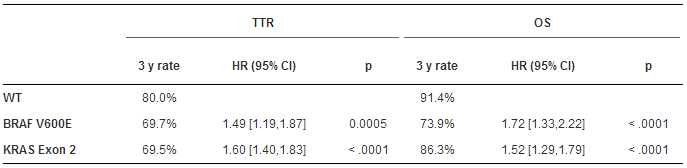
一共入組5577例,僅對3934例MSS患者評估BRAF和KRAS基因;其中279例BRAF突變,1450例KRAS突變,以及2205例雙重WT。與WT組不同,突變兩組的TTR和OS較短,且多因素分析也證實該結果(表)。WT組,KRAS突變組,BRAF突變組的中位SAR分別為2.57,2.09和1.0年,其中KRAS(HR:1.20-95%CI:1.01-1.44,P<0.0001),BRAF突變組(HR:3.01-95%CI:2.32-3.93,P<0.0001)。本項研究中治療(聯合或不聯合西妥昔單抗)和KRAS/BRAF雙突變的TTR(P值=0.38)和OS(P值=0.16)無明顯差異。
結論:
本項研究通過一項大型III期術后結腸癌接受FOLFOX輔助治療試驗的匯總分析,發現BRAF V600E或KRAS 外顯子2,包括密碼子12或13突變,是TTR,SAR和OS的獨立預測因子。在以后的臨床試驗輔助試驗中應將這些突變納入為重要分層因素。
會議專題》》》2015年ASCO年會專題報道
Prognostic value of BRAF V600E and KRAS exon 2 mutations in microsatellite stable (MSS), stage III colon cancers (CC) from patients (pts) treated with adjuvant FOLFOX+/- cetuximab: A pooled analysis of 3934 pts from the PETACC8 and N0147 trials.(Abstract 3507)
Authors:Julien Taieb, Karine Le Malicot,et al.
Session Type:Oral Abstract Session
Background: The prognostic value of BRAF and KRAS mutations in resected CC pts remains controversial due to published studies that include stage II & III, microsatellite instability (MSI) and MSS, colon and rectal tumors, and variable treatment regimens. We examined this question in prospectively collected biospecimens from MSS stage III CC pts receiving adjuvant FOLFOX +/- cetuximab.
Methods:Tumors were analyzed for BRAF V600E and KRAS exon 2 mutations, only MSS tumors were included. Three groups were defined: BRAF Mutant, KRAS Mutant and double wild-type (WT). The analytic strategy estimated study- and arm-specific prognostic effects to assess homogeneity of results, and then analysis of pooled data. Associations of mutations with time-to-recurrence (TTR), survival after relapse (SAR) and overall survival (OS) were analysed using a stratified Cox proportional hazards model. Multivariate models were adjusted for treatment and covariates (age, sex, tumor grade, T/N stage, tumor location, ECOG PS).
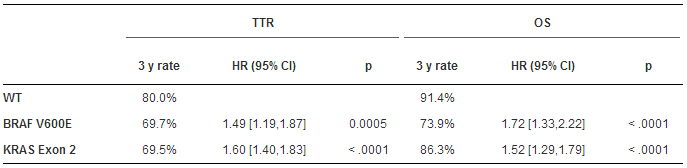
Results:Of the 5,577 pts enrolled, 3,934 tumors were MSS and evaluable for BRAF and KRAS; 279 pts were BRAF Mutant, 1,450 KRAS Mutant, and 2,205 WT. Both mutations were linked to shorter TTR and OS vs WT, and results were confirmed in multivariate analyses (table). Median SAR was 2.57, 2.09 and 1.0 year in WT, KRAS Mutant (HR: 1.20- 95%CI: 1.01-1.44, p < 0.0001) and BRAF mutant (HR: 3.01-95%CI: 2.32-3.93, p < 0.0001), respectively. No interaction was found between treatment (with or without cetuximab) and KRAS/BRAFmutations for TTR (p = 0.38) or OS (p = 0.16).
Conclusions:In a large pooled analysis of pts with resected stage III MSS colon cancers receiving adjuvant FOLFOX, BRAFV600E or KRAS exon 2 mutations, including codons 12 or 13, are independent predictors of significantly shorter TTR, SAR and OS. Future clinical trials in the adjuvant setting should consider these mutations as important stratification factors.